Florida Mold Assessor Licensing: Why It Matters Who Inspects Your Building

Jonnatan R. Mendez, PE, SI • September 25, 2026

Share this article

No. Slip resistance is one input. A sound opinion reads it alongside the surface condition, any contaminant, footwear, lighting, and maintenance history.

  • The fee owner, or the contractor with the owner's written authorization, signs a written contract with the private provider or the provider's firm.
  • The building official is notified in writing, at the time of permit application, of the services the private provider will perform, with each provider's license number and qualifications and, if the official requires it, a certificate of insurance.
  • The private provider reviews the plans for compliance with the applicable codes and signs an affidavit, under oath, that the provider reviewed them, holds the appropriate license, and found that they comply.
  • The building official has 20 business days after receiving the application and affidavit, or 5 business days for a single-trade review on a one or two family dwelling, to issue the permit or give written notice of the specific plan features that do not comply, citing code chapters and sections.
  • If the private provider is a licensed engineer or architect who seals the affidavit, that period is 10 business days, and a notice must state with specificity the deficiencies, the reasons the application failed, and the codes violated.
  • If no deficiency notice arrives in time, the application is deemed approved as a matter of law and the permit must be issued the next business day. After revisions, the official has the remaining time plus 5 business days, and later reviews are limited to the deficiencies already cited.
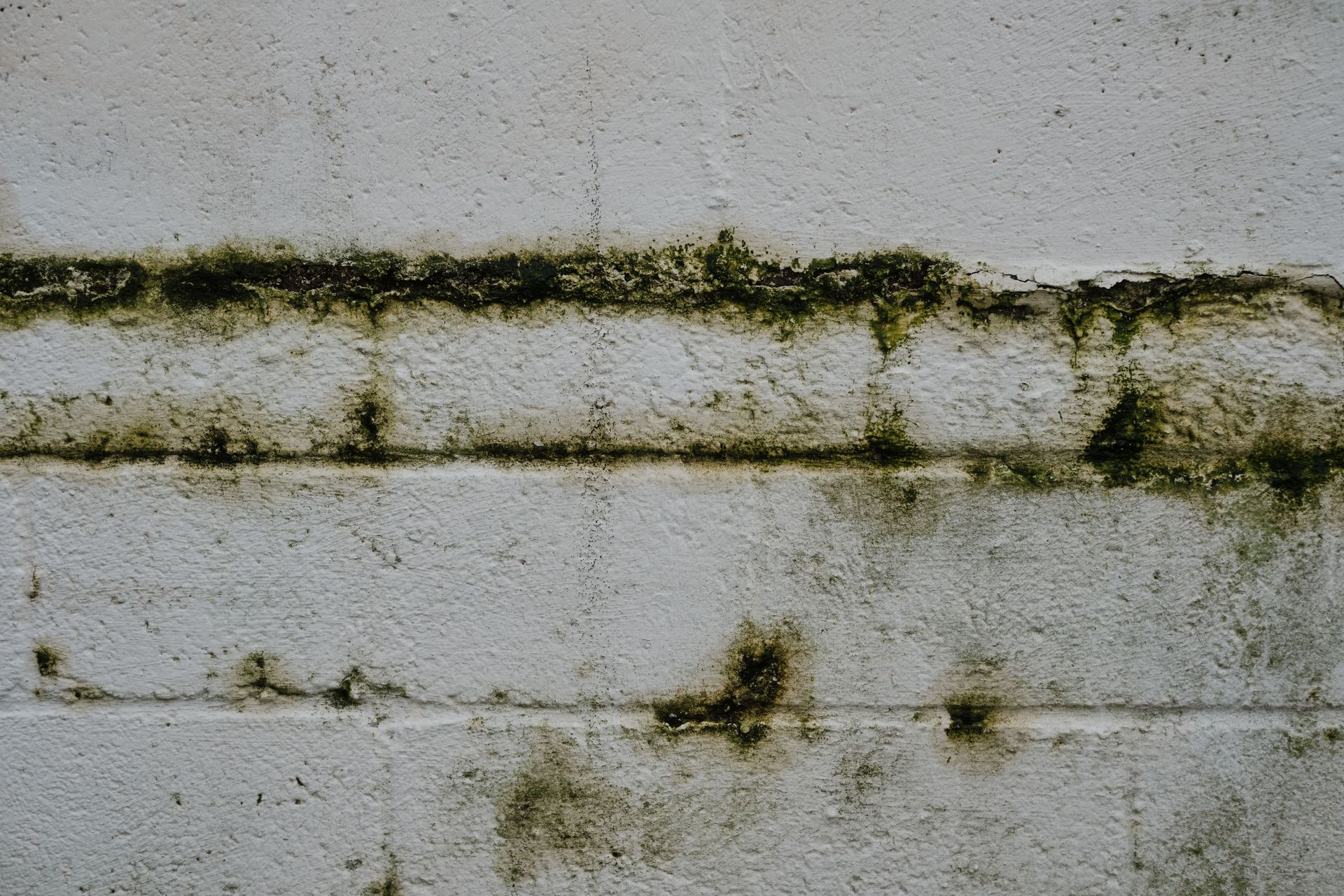
White painted wall with horizontal cracks and dark green moss stains

The Short Version

Florida licenses the people who assess and remediate mold. Under Part XVI of Chapter 468 of the Florida Statutes, anyone who performs a mold assessment or mold remediation involving more than 10 square feet of growth must hold an individual license from the Department of Business and Professional Regulation. The same law keeps the two jobs apart: a licensed assessor may not remediate a structure the assessor or the assessor's company assessed within the last 12 months, and a remediator may not assess a structure it remediated in that time.

That separation is the most important thing to understand before you hire anyone for a mold assessment in Miami. The person who tells you how much mold there is, where it is, and what has to be removed should not be the person who gets paid to remove it. The rest of this guide explains what the license covers, how the conflict of interest rule works, and what a professional engineer adds when the real question is where the water came from.

What Part XVI Licenses

The definitions in Fla. Stat. 468.8411 set the scope. A mold assessment is a process performed by a mold assessor that includes physical sampling and detailed evaluation of data from a building history and inspection to form an initial hypothesis about the origin, identity, location and extent of mold growth greater than 10 square feet. A mold assessor is anyone who performs or directly supervises that work. Mold remediation is the removal, cleaning, sanitizing, demolition or other treatment of mold or mold-contaminated material over the same 10 square foot threshold.

The Department of Business and Professional Regulation administers the program under Part XVI and Rule 61-31 of the Florida Administrative Code, and
its published guidance fills in the practical requirements.

  • Only individuals are licensed. The department does not license mold assessment or remediation businesses, so the license belongs to the person who does the work.
  • Applicants need either a two-year degree in a related field such as microbiology, engineering, architecture or industrial hygiene with a year of field experience, or a high school diploma with four years of documented experience, plus documented training in water, mold and respiratory protection.
  • Applicants must pass a state-approved examination and a criminal background check.
  • A mold assessor must carry general liability and errors and omissions coverage of at least $1,000,000, either personally or as a named individual on the company's policy.
  • Licensees renew every two years and complete 14 hours of continuing education in mold-related subjects for each renewal.

The Assessor Versus Remediator Rule

Section 468.8419 is where the conflict of interest rule sits. A mold assessor may not perform or offer to perform mold remediation on a structure on which the assessor or the assessor's company provided a mold assessment within the last 12 months. The mirror rule bars a remediator from assessing a structure the remediator or the remediator's company remediated within the last 12 months. The department's own guidance quotes both provisions when it explains that a company doing both kinds of work needs both licenses.

The reason is simple. A company that will be paid to remove mold has an incentive to find more of it, and a company that has just removed it has an incentive to find that the work succeeded. Separating the two keeps the scope honest at the start and the clearance honest at the end. The statute has one narrow exception: a certified Division I contractor may assess and offer to remediate, subject to any department rule requiring the contract to tell the homeowner of the right to request competitive bids.

Section 468.8419 goes further than the 12 month rule. It bars an assessor from inspecting for a fee any property in which the assessor or the assessor's company has a financial or transfer interest, and it bars remediators from paying or accepting referral fees from assessors. Violations are crimes, starting as a second degree misdemeanor and rising to a third degree felony for repeat violations.

Titles, Exemptions and What They Mean for You

The statute also protects the title. A person may not call himself or herself a licensed, certified, registered or professional mold assessor, or simply a mold assessor, without complying with Part XVI. That makes the title on a proposal or report a meaningful claim that can be checked.

Some licensed professionals are exempt when they work within the scope of their own licenses. The department explains that Section 468.841 exempts people acting within the authorized scope of practice of another license, but that anyone relying on the exemption may not hold themselves out for hire as a licensed mold assessor or remediator. In practice, a report that calls itself a mold assessment should come from someone whose mold assessor license you can look up.

What a Mold Assessment Should Include

The license sets a minimum. A useful assessment goes beyond counting spores and tells you what to do next. A complete one usually covers these steps.

  • A review of the leak and moisture history, earlier repairs, reported events, photographs and any construction documents.
  • A field assessment with visual observation, moisture measurements, relative humidity readings, thermal imaging where appropriate, and sampling when the conditions warrant it.
  • An evaluation of the likely moisture source and migration path, and the apparent extent of affected materials, including concealed conditions that need selective investigation.
  • A written remediation protocol that defines the affected areas, containment, removal and cleaning procedures, and the criteria for clearing the work.
  • Post-remediation verification after the work is done and before walls, ceilings or floors are closed up again.

What a Professional Engineer Adds

Mold is almost always a symptom. It grows where water has been, and in South Florida buildings that water usually comes through a roof, a window, a stucco wall, a slab, a plumbing line or an air conditioning system. If the remediation removes the mold but nobody finds and fixes the source, the growth comes back. That is where engineering matters. A professional engineer who is also a licensed mold assessor can trace the moisture through the building envelope, identify the construction or maintenance condition behind it, and specify the repair.

The engineering also matters when someone has to pay. Insurance claims and disputes turn on causation: whether water damage came from a storm, a construction defect, a plumbing failure or long-term deterioration. That is the same kind of analysis our
forensic engineering practice performs on hurricane damage, and it is what an adjuster, a condominium board or opposing counsel needs to see in the report. Long-term water intrusion can also affect the structure itself, from rotted framing to corroding reinforcement, which is why moisture damage is often first found during milestone inspections.

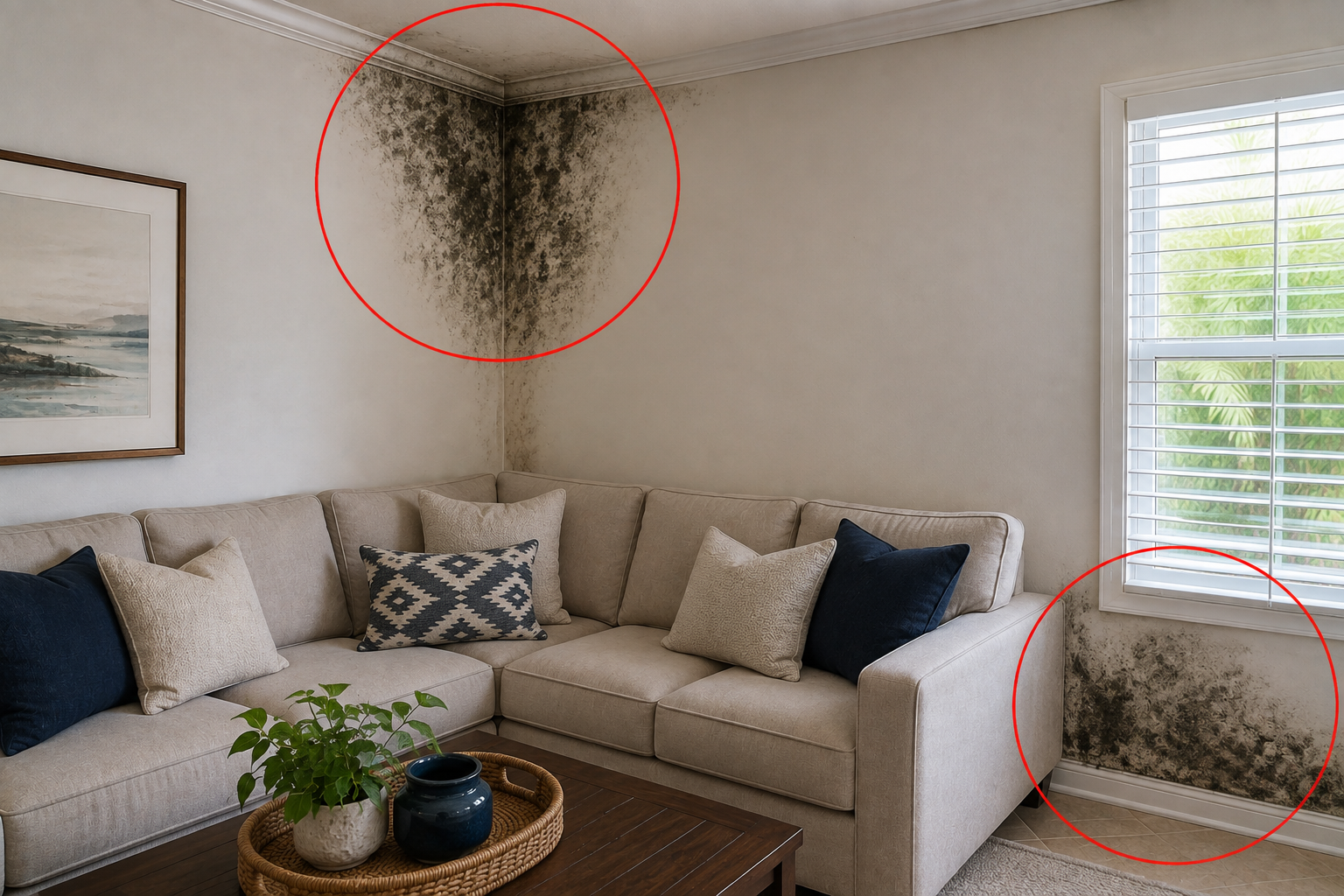
Living room with mold growth circled at a ceiling corner and along the wall below a window

Hiring for a Mold Assessment in Miami

Before you hire anyone, a few questions will tell you whether you are getting an independent assessment. The answers should be easy to give.

  • What is your Florida mold assessor license number? Check it on the state's public licensee search before the visit.
  • Does your company, or a company you are connected with, perform mold remediation, and would it bid on this job?
  • Will the report identify the moisture source, or only the mold?
  • Will you write the remediation protocol, and will you perform the post-remediation verification?
  • What insurance do you carry, and are you named on the policy?

Mistakes That Make Mold Come Back

Most repeat mold problems trace back to how the first assessment was handled. These are the ones we see most often.

  • Accepting a free inspection from a company that expects to be paid for the remediation.
  • Sampling the air without looking for the water, which confirms mold is present but not why.
  • Starting remediation with no written protocol, so there is no agreed scope and no clear standard for clearance.
  • Skipping post-remediation verification and closing walls over materials that are still wet or contaminated.
  • Repairing the drywall but not the roof, window, stucco or plumbing condition that caused it.

How M&P Consulting Engineers Approaches Mold Assessment

Jonnatan R. Mendez, PE, SI, is a licensed Professional Engineer and a licensed mold assessor, so our mold work is led by someone who can evaluate both the growth and the building behind it. We provide mold assessment and related investigative services only and do not perform mold remediation or removal work, which keeps every assessment independent of the remediation that follows.

Our assessments combine mold assessment practice with moisture mapping, thermal imaging where appropriate, and building science, and our reports document conditions, sampling results where taken, the likely moisture source, and a remediation protocol when one is required. When a claim or dispute follows, the same engineer can provide causation opinions and expert testimony. Active leaks and occupied-unit complaints are usually scheduled within a few business days in Miami-Dade, Broward and Palm Beach, including Coral Gables, Doral, Hialeah and Hollywood.

Common Questions About Florida Mold Assessor Licensing

  • Do I need a licensed mold assessor for a small patch of mold?

    Part XVI applies to assessment and remediation of mold growth greater than 10 square feet. Smaller areas fall outside those definitions, but visible growth can be the edge of a larger hidden problem, so the size you can see is not always the size that is there.

  • Can the company that tested my home also remove the mold?

    Generally not within 12 months. Section 468.8419 bars an assessor or the assessor's company from remediating a structure it assessed in the last 12 months. A certified Division I contractor is the narrow exception.

  • How do I check a mold assessor's license?

    Use the Department of Business and Professional Regulation's public licensee search. Search by name or license number and confirm the mold assessor license is current.

  • Is mold sampling always necessary?

    No. Sampling can be useful, but it should be driven by the conditions and the questions being asked. Finding and measuring the moisture is usually more important than a spore count on its own.

  • Does a mold remediator need a license too?

    Yes, for remediation of more than 10 square feet. A remediator also may not perform work that requires a contractor license under Chapter 489 unless licensed under that chapter or the work complies with it.

Mold Returning in the Same Area?

M&P Consulting Engineers provides independent mold assessments led by a licensed Professional Engineer and mold assessor, with moisture source investigation and remediation protocols. Call 866-531-7621 with the address, photographs and any leak history.

Sources

Fla. Stat. 468.8411, Definitions, and 468.8419, Prohibitions; penalties (Chapter 468, Part XVI, Mold-Related Services), Florida Legislature. Checked 25 September 2026.

Florida Administrative Code, Rule 61-31, Mold-Related Services.

Florida Department of Business and Professional Regulation, Mold-Related Services FAQs. Checked 25 September 2026.

Florida Department of Business and Professional Regulation, Licensee Search.

Recent Posts

By Jonnatan R. Mendez, PE, SI • October 5, 2026
What a structural engineer expert witness does in Florida litigation, explained by a licensed Miami engineer. The Daubert standard under Fla. Stat. 90.702, why it applies to engineers, and what makes testimony survive a challenge. Call 866-531-7621.
By Jonnatan R. Mendez, PE, SI • September 30, 2026
Threshold building inspections in Florida, explained by a Miami structural engineer. What makes a building a threshold building, what a special inspector does under Fla. Stat. 553.79, who can serve, and how it differs from a milestone inspection. Call 866-531-7621.
By Jonnatan R. Mendez, PE, SI • September 25, 2026
Florida's condo safety laws after Surfside, explained by a Miami structural engineer: SB 4-D (2022), SB 154 (2023) and HB 913 (2025), what each one changed for milestone inspections and SIRS, and the deadlines that apply now. Call 866-531-7621.
Corner balconies on a coastal condo tower in Palm Beach Shores, assessed by M&P Consulting Engineers
By Jonnatan R. Mendez, PE, SI • September 25, 2026
What changed after the Surfside condo collapse: NIST's June 2026 technical findings, SB 4-D, SB 154 and HB 913, and the milestone inspection mistakes Florida condo boards still make. Call 866-531-7621.
Structural drawing with plan, wall sections and details, ready for a Florida PE to sign and seal
By Jonnatan R. Mendez, PE, SI • September 25, 2026
What a Florida professional engineer seal means under Chapter 471: what must be signed and sealed, physical, digital and electronic sealing under Rule 61G15-23, and how to verify an engineer's license. Call 866-531-7621.
Drawing sheet with floor plan, wall sections and details, as checked in a structural plans review
By Jonnatan R. Mendez, PE, SI • September 25, 2026
Structural plans review in Florida for municipalities and developers: contract plan review under Fla. Stat. 468, private provider review and deadlines under 553.791, and how independent peer review differs. Call 866-531-7621.
Concrete balconies on a Palm Beach Shores beachfront building, evaluated by M&P Consulting Engineers
By Jonnatan R. Mendez, PE, SI • September 25, 2026
Concrete spalling balcony inspection in coastal Florida, explained by a structural engineer: how rebar corrosion causes spalling, what inspectors look for, when it triggers a Phase 2 milestone inspection, and how ACI 562 repairs work. Call 866-531-7621.

Stone-facade South Florida home with lush garden, a renovation type M&P Consulting Engineers reviews
By Jonnatan R. Mendez, PE, SI • September 24, 2026
The FEMA 50 percent rule in Florida, explained by a Miami structural engineer: how substantial improvement is calculated, Miami-Dade's cumulative counting and freeboard rules, and what an AE zone renovation must meet if it crosses the line. Call 866-531-7621.

One-story South Florida home with dark roof and yard, typical of M&P Consulting Engineers projects
By Jonnatan R. Mendez, PE, SI • September 24, 2026
Do you need a structural engineer to remove a wall in Miami-Dade? A licensed Miami engineer explains load-bearing walls, permits, the Florida Building Code rules and sealed drawings under Fla. Stat. 471, for homeowners planning an open layout. Call 866-531-7621.
3D structural analysis model of two building frames for wind load design by M&P Consulting Engineers
By Jonnatan R. Mendez, PE, SI • September 24, 2026
The high velocity hurricane zone explained by a Miami structural engineer for architects and contractors: FBC Chapter 16 HVHZ wind loads and impact tests, Miami-Dade NOA product approval, and how design pressures and approvals fit together. Call 866-531-7621.

Show More