
Chapter 471 and the PE Seal: What 'Signed and Sealed' Means and Why Florida Requires It

Jonnatan R. Mendez, PE, SI • September 25, 2026

Share this article

No. Slip resistance is one input. A sound opinion reads it alongside the surface condition, any contaminant, footwear, lighting, and maintenance history.

Engineer in a hard hat writing at a desk with blueprints and rolled plans

The Short Version

A Florida professional engineer seal on a drawing, report or set of calculations is a legal statement, not a decoration. Under Chapter 471 of the Florida Statutes, every final engineering document filed for public record or delivered to an owner must be signed, dated and sealed by the licensed engineer who prepared it, and that signature, date and seal are the evidence that the document is authentic. By sealing it, the engineer takes personal professional responsibility for its content.

For owners, contractors, lenders and building departments, the seal answers three questions at once: who prepared the document, whether that person is licensed to do so, and whether the document is final. Knowing how the seal works, and how to check one, protects everyone who relies on the engineering, which is why every
structural design and analysis package we issue is sealed by the engineer in responsible charge.

What Chapter 471 Requires

Fla. Stat. 471.025 is the seal statute. It requires each licensed engineer to have a seal and to sign, date and seal all final drawings, specifications, plans, reports and documents the engineer prepares or issues that are filed for public record, and all final documents provided to the owner or the owner's representative. Documents may be transmitted, signed, dated and sealed electronically under Florida's electronic signature law.

The same section sets three limits that matter to anyone relying on a sealed document.

  • It is unlawful to seal or digitally sign any document after the engineer's license has expired or been revoked or suspended, unless the license has been reinstated.
  • An engineer may not seal any document depicting work the engineer is not licensed to perform or that is beyond the engineer's profession or specialty.
  • A successor engineer who reuses documents previously sealed by another engineer must be able to independently re-create the original work, and by sealing them assumes full professional and legal responsibility for them.

Chapter 471 also lists grounds for discipline, including affixing or permitting to be affixed a seal, name or digital signature to documents that were not prepared by the engineer or under the engineer's responsible supervision, direction or control.

What the Seal Means

The Florida Board of Professional Engineers explains the purpose plainly. By signing, dating and sealing a document, an engineer verifies its authenticity and accepts responsibility for its accuracy and legitimacy. The seal lets the agency reviewing it know who prepared it and whom to contact with comments or questions, and it indicates that the document is final.

The board's rules add two important conditions. Under Rule 61G15-23.001, an engineer may only sign, date and seal a document if the engineer was in responsible charge of its preparation and has expertise in the engineering discipline used to produce it. The same rule presumes that sealed documents comply with the codes and standards in effect at the time of sealing, unless the engineer indicates on the documents that another edition was intended. The seal is tied to a specific person, a specific discipline and a specific point in time.

Three Ways to Sign and Seal

Florida recognizes physical, digital and electronic signing and sealing, each with its own procedure under Chapter 61G15-23 of the Florida Administrative Code. Which one an engineer uses usually depends on how the receiving agency wants the documents filed.

Physical Signing and Sealing

The engineer signs each sheet by hand and applies a wet, embossed or digitally created seal that partially overlaps the signature without making it illegible. The seal must be at least 1 7/8 inches in diameter. A scanned, facsimile, digitally created or copied image of the signature may not be used, and FBPE is explicit that scanned or electronic copies of physically sealed documents are not considered signed and sealed.

Digital Signing and Sealing

A digital signature must be unique to the engineer, issued by a third-party certification authority, capable of verification, under the engineer's sole control, and linked to the document so that any change invalidates it. FBPE notes that the self-authenticated signature option built into common PDF software does not qualify on its own. The signed file carries required text stating that it has been digitally signed and sealed and that the signature must be verified on any electronic copies.

Electronic Signing and Sealing

The electronic method runs the document files through a secure hash standard generator, which produces an authentication code for each file. The engineer lists those codes on a signature report, then prints, hand signs, dates and seals the report and sends it with the files. Printed copies of electronically sealed documents are not considered signed and sealed, and simply locking or encrypting a file is not a signature.

What Must Be Sealed and What Should Not Be

The requirement covers final documents. Final plans and prints, specifications, calculations and engineering reports that are filed for public record or provided to the owner must be sealed. The rules also set out what those documents must show, and the most common requirements are these.

  • On physically sealed plans, every sheet is signed, dated and sealed by the engineer in responsible charge.
  • Each sheet carries a title block with the engineer's printed name, address and license number, and the name and address of the engineering business where applicable.
  • Specifications and calculations can use a sealed index sheet showing which sections each engineer was in responsible charge of.
  • The date of sealing appears next to the seal.

Documents that are not final should not be sealed unless their limits are marked on them, with words such as "preliminary," "for review only" or "not for construction." A sealed drawing with no such note tells the reader it is final.

How to Check a Seal

Anyone can check a Florida engineer's license, and anyone relying on sealed documents should. The state's Department of Business and Professional Regulation runs the public licensee search that FBPE links to, and it shows whether a license is current. A basic check takes a few minutes.

  • Look up the engineer by name or license number and confirm the license is active and was active on the date of sealing.
  • Confirm the name and license number in the title block match the seal and the license record.
  • For a digitally sealed PDF, open the signature panel and confirm the signature is valid and the document has not changed since it was signed.
  • For electronically sealed files, confirm there is a signed and sealed signature report whose authentication codes match the files.
  • Treat a scanned copy of a hand-sealed set, or a printout of an electronically sealed file, as a copy, not as sealed documents.
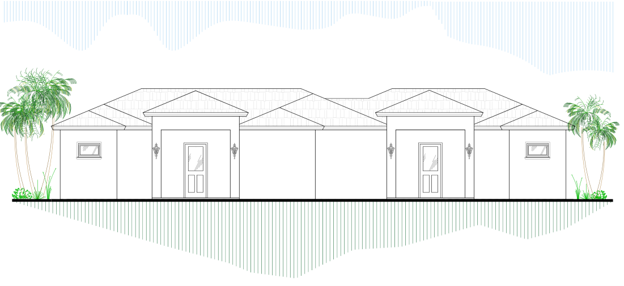
Line drawing of a single-story house elevation, the kind of sheet that must carry an engineer's title block and seal

Why It Matters on Real Projects

Sealed documents run through almost every stage of a Florida building project. Permit portals in South Florida require plans to be digitally signed and sealed, which is why a structural change as ordinary as removing a load-bearing wall needs sealed drawings. The High-Velocity Hurricane Zone relies on sealed drawings to carry the design pressures that product approvals are checked against, and flood zone renovations need sealed foundation plans when they cross the substantial improvement threshold.

The seal carries weight in review and inspection too. When a
private provider who is a licensed engineer seals the plan review affidavit under Fla. Stat. 553.791, the building official has 10 business days, rather than 20, to act. Milestone inspection reports are submitted as sealed copies, and threshold inspection reports are signed and sealed throughout a repair. In a dispute, the seal identifies the engineer whose work will be examined against the standard of care.

Mistakes That Undermine a Seal

Most seal problems are avoidable, and several of them are violations rather than mere errors. These are the ones owners and contractors should watch for.

  • Accepting a scanned image of a seal and signature as if it were a sealed document.
  • Reusing drawings sealed by another engineer for a new permit or revision without a successor engineer taking responsibility for them.
  • Sealing work prepared by someone outside the engineer's responsible supervision, sometimes called plan stamping.
  • Relying on a document sealed while the engineer's license was lapsed or suspended.
  • Relying on a seal outside the engineer's discipline, such as structural drawings sealed by an engineer with no structural expertise.
  • Editing a digitally sealed PDF after the fact, which invalidates the signature.

How M&P Consulting Engineers Seals Its Work

Every final deliverable we issue, whether structural drawings, calculations, inspection reports or forensic reports, is signed, dated and sealed by the Professional Engineer who was in responsible charge of it. Each engagement has direct involvement from the principal, from the first evaluation through the sealed document, so the name on the seal is the person who did the engineering.

Jonnatan R. Mendez, PE, SI, holds PE licensure in 16 or more U.S. jurisdictions, including Florida, maintains an NCEES Record for multi-state licensure, and is a Florida Threshold Building Special Inspector. His Florida license can be verified on the state's public licensee search by searching his name.

Common Questions About the Florida PE Seal

  • Can any licensed engineer seal any engineering drawing?

    No. Florida law bars an engineer from sealing work beyond his or her profession or specialty, and the board's rules require both responsible charge and expertise in the discipline involved.

  • Is a scanned copy of sealed plans still sealed?

    No. FBPE states that scanned or electronic copies of physically signed and sealed documents are not considered signed and sealed. Building departments that accept electronic plans expect them to be digitally or electronically sealed.

  • Can a new engineer revise drawings sealed by someone else?

    Yes, as a successor engineer. The new engineer must be able to independently re-create the original work, and by sealing the documents takes full professional and legal responsibility for them.

  • Do I need an engineer's seal to work on my own house?

    Chapter 471 has a narrow exemption for owners doing engineering on their own property where public safety is not involved, but building departments usually require sealed drawings for structural changes. Our guide to wall removal explains how that works in practice.

  • How do I verify an engineer's Florida license?

    Use the Department of Business and Professional Regulation licensee search, which FBPE links to from its website. Search by name or license number and check that the license is active.

Need Sealed Structural Documents?

M&P Consulting Engineers prepares signed and sealed structural drawings, calculations and reports for owners, contractors, designers and building departments across South Florida. Call 866-531-7621 to talk directly with the engineer who will seal your documents.

Sources

Fla. Stat. 471.025, Seals, and Fla. Stat. 471.033, Disciplinary proceedings, Florida Legislature. Checked 25 September 2026.

Florida Administrative Code, Chapter 61G15-23, Seals (Rules 61G15-23.001 to 61G15-23.005).

Florida Board of Professional Engineers, Signing and Sealing Engineering Documents. Checked 25 September 2026.

Florida Department of Business and Professional Regulation, Licensee Search.

Recent Posts

By Jonnatan R. Mendez, PE, SI • October 5, 2026
What a structural engineer expert witness does in Florida litigation, explained by a licensed Miami engineer. The Daubert standard under Fla. Stat. 90.702, why it applies to engineers, and what makes testimony survive a challenge. Call 866-531-7621.
By Jonnatan R. Mendez, PE, SI • September 30, 2026
Threshold building inspections in Florida, explained by a Miami structural engineer. What makes a building a threshold building, what a special inspector does under Fla. Stat. 553.79, who can serve, and how it differs from a milestone inspection. Call 866-531-7621.
By Jonnatan R. Mendez, PE, SI • September 25, 2026
Florida's condo safety laws after Surfside, explained by a Miami structural engineer: SB 4-D (2022), SB 154 (2023) and HB 913 (2025), what each one changed for milestone inspections and SIRS, and the deadlines that apply now. Call 866-531-7621.
Corner balconies on a coastal condo tower in Palm Beach Shores, assessed by M&P Consulting Engineers
By Jonnatan R. Mendez, PE, SI • September 25, 2026
What changed after the Surfside condo collapse: NIST's June 2026 technical findings, SB 4-D, SB 154 and HB 913, and the milestone inspection mistakes Florida condo boards still make. Call 866-531-7621.
Dark mold growth spreading up an interior wall corner, the kind a licensed mold assessor evaluates
By Jonnatan R. Mendez, PE, SI • September 25, 2026
Before you hire for a mold assessment in Miami: how Florida licenses mold assessors under Fla. Stat. 468 Part XVI, the 12 month assessor versus remediator rule, and what a licensed PE adds. Call 866-531-7621.
Drawing sheet with floor plan, wall sections and details, as checked in a structural plans review
By Jonnatan R. Mendez, PE, SI • September 25, 2026
Structural plans review in Florida for municipalities and developers: contract plan review under Fla. Stat. 468, private provider review and deadlines under 553.791, and how independent peer review differs. Call 866-531-7621.
Concrete balconies on a Palm Beach Shores beachfront building, evaluated by M&P Consulting Engineers
By Jonnatan R. Mendez, PE, SI • September 25, 2026
Concrete spalling balcony inspection in coastal Florida, explained by a structural engineer: how rebar corrosion causes spalling, what inspectors look for, when it triggers a Phase 2 milestone inspection, and how ACI 562 repairs work. Call 866-531-7621.

Stone-facade South Florida home with lush garden, a renovation type M&P Consulting Engineers reviews
By Jonnatan R. Mendez, PE, SI • September 24, 2026
The FEMA 50 percent rule in Florida, explained by a Miami structural engineer: how substantial improvement is calculated, Miami-Dade's cumulative counting and freeboard rules, and what an AE zone renovation must meet if it crosses the line. Call 866-531-7621.

One-story South Florida home with dark roof and yard, typical of M&P Consulting Engineers projects
By Jonnatan R. Mendez, PE, SI • September 24, 2026
Do you need a structural engineer to remove a wall in Miami-Dade? A licensed Miami engineer explains load-bearing walls, permits, the Florida Building Code rules and sealed drawings under Fla. Stat. 471, for homeowners planning an open layout. Call 866-531-7621.
3D structural analysis model of two building frames for wind load design by M&P Consulting Engineers
By Jonnatan R. Mendez, PE, SI • September 24, 2026
The high velocity hurricane zone explained by a Miami structural engineer for architects and contractors: FBC Chapter 16 HVHZ wind loads and impact tests, Miami-Dade NOA product approval, and how design pressures and approvals fit together. Call 866-531-7621.

Show More